
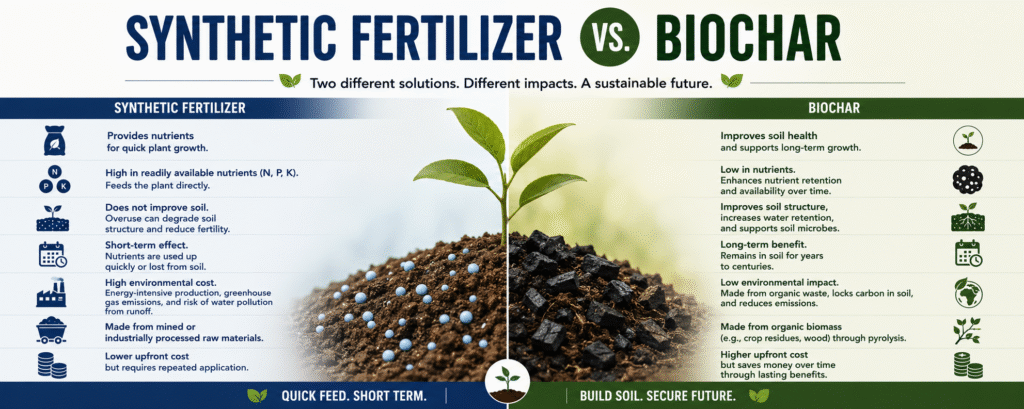
𝐓𝐡𝐞 𝐒𝐲𝐧𝐭𝐡𝐞𝐭𝐢𝐜 𝐅𝐞𝐫𝐭𝐢𝐥𝐢𝐳𝐞𝐫 𝐓𝐫𝐚𝐩, 𝐒𝐨𝐢𝐥 𝐄𝐫𝐨𝐬𝐢𝐨𝐧, 𝐚𝐧𝐝 𝐖𝐡𝐲 𝐁𝐢𝐨𝐜𝐡𝐚𝐫 𝐈𝐬 𝐍𝐨𝐭 𝐉𝐮𝐬𝐭 𝐚 𝐒𝐨𝐥𝐮𝐭𝐢𝐨𝐧 — 𝐈𝐭 𝐈𝐬 𝐚 𝐖𝐚𝐫𝐧𝐢𝐧𝐠
We have built modern agriculture on a dangerous illusion: that we can endlessly extract from the soil without giving back. That illusion now has a price tag — and the planet is paying it.
Excessive use of synthetic fertilizers has led to soil degradation affecting 40% of arable land globally. Nitrogen runoff alone contributes to 30% of water pollution, devastating aquatic ecosystems. Yet we keep doubling down. The global fertilizers market reached $216 billion in 2024 — a number that should alarm, not impress us.
Here is the cruel irony that farmers rarely speak about publicly: a 2020 study by the University of Colorado estimated that one-third of the fertilizer used in corn production goes simply towards compensating for “ongoing loss of soil fertility” — resulting in ever-greater input costs every year. We are spending more money to stand still. And in doing so, synthetic fertilizer application begins the destruction of soil biodiversity by suppressing the role of nitrogen-fixing bacteria — the very organisms that could make synthetic fertilizers unnecessary in the first place.
Chemical fertilizers, particularly nitrogen-based ones, release nitrous oxide (N₂O), a greenhouse gas nearly 300 times more potent than CO₂, significantly accelerating global warming. The solution we invented to feed people is now destabilizing the climate that food production depends on. This is not a side effect. It is a structural contradiction.
Biochar: The Answer Hidden in Our Waste
Enter biochar — and here is where the science becomes both hopeful and humbling.
Biochar, a carbon-rich material produced through the pyrolysis of organic biomass, has gained increasing attention as a sustainable soil amendment due to its potential to enhance soil health, improve agricultural productivity, and mitigate climate change. Its unique porous structure, high cation exchange capacity, and nutrient retention capabilities significantly enhance soil fertility, water-holding capacity, and microbial activity.
The numbers are striking. Biochar reduces CO₂, CH₄, and N₂O emissions in non-arid climates by −18%, −38%, and −40%, respectively, relative to unamended control soils. Biochar amendment can enhance gross soil organic carbon by nearly 27%, while improving soil fertility and decreasing nutrient leaching, thus enhancing plant growth and crop productivity.
A 2024 field study found that incorporating nanobiochar into saline-sodic soils reduced exchangeable sodium percentage by 18% and increased wheat biomass by 27% — results that matter enormously for food-stressed regions like South Asia, the Sahel, and the Middle East.
But here is the part most conversations miss entirely.
The Circular Trap: Destroy the Soil, Lose the Biochar
Biochar is not a product you manufacture in isolation. It is — by scientific definition — a product of organic biomass. The production of biochar involves heating organic feedstocks such as agricultural residues, forestry by-products, or municipal waste at temperatures typically ranging from 400°C to 700°C in an oxygen-limited environment. These by-products can serve as renewable energy sources, contributing to the circular economy.
This means: no healthy biomass, no biochar. No biochar, no soil amendment. No soil amendment, no biomass. The circle is unbreakable — and we are breaking it.
Good stewardship of soil health by minimizing regular fertilizer use is one of the many steps to climate change mitigation. The role of biochar in improving soil profile and engendering carbon sequestration is astonishing. But that role depends entirely on abundant, diverse organic material — crop residues, compost, forest litter, agricultural waste — all of which are byproducts of a living soil structure.
When we compact soils through heavy machinery, strip organic matter through mono-cropping, and acidify land through chemical overuse, we are not just degrading today’s harvest. We are eliminating the raw material for tomorrow’s remedy. Biochar characteristics — including microbial activity, mineral and nutrient binding, and soil water holding capacity — depend on the physical structure, pore size, and surface area of the feedstock used to produce the biochar. Degraded feedstock produces degraded biochar. Absent biomass produces nothing.
What Needs to Change — Now
The science is clear. Biochar has shown strong potential to reduce greenhouse gas emissions, enhance carbon sequestration, and immobilize soil contaminants such as heavy metals and organic pollutants. Researchers at Bangladesh Agricultural University and Hanyang University in Seoulhave both contributed to understanding how biochar interacts with local soils across Asia — noting that biochar made from agricultural residue typically has greater nutrient content and a higher pH, making it highly suited to acidic tropical soils.
But technology without ecology is just another shortcut. What we need is a systemic shift — toward treating soil not as a substrate for chemicals, but as a living ecosystem with its own rights, rhythms, and reciprocities.
The ancient Amazon civilizations understood this. Their terra preta — dark, biochar-enriched soils — remain fertile after 2,500 years, without a single bag of synthetic fertilizer. Nature already wrote the manual. We just stopped reading it.
The Time Is Now
Biochar amendment could help achieve United Nations Sustainable Development Goals including climate action (SDG 13), clean water and sanitation (SDG 6) — but only if we protect the ecological cycle that makes biochar possible in the first place.
Restore the soil. Protect the biomass. Close the loop.
The eco-cycle of nature is not a metaphor. It is the only operating system that has ever truly worked — and it is time we stopped treating it like a legacy system we can replace.
What steps is your organization taking toward regenerative soil practices? Let’s talk in the comments.